
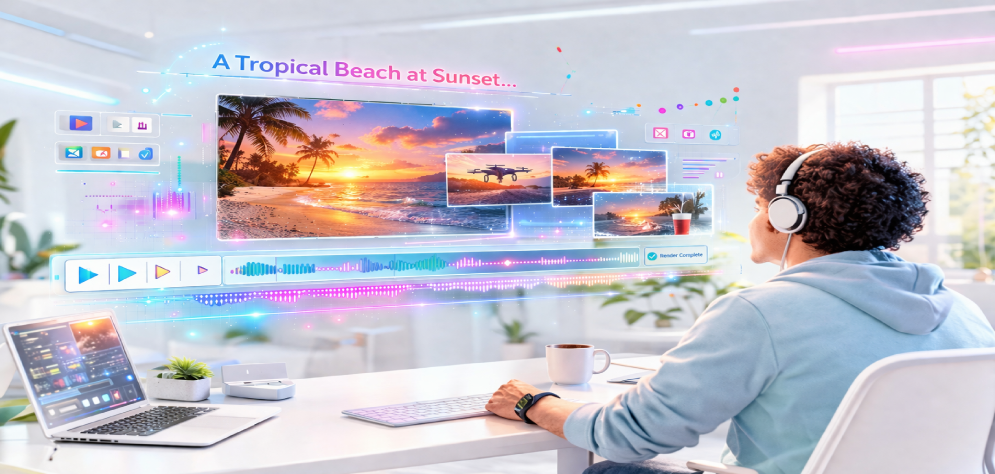
The way we create content is undergoing a seismic shift. What once required expensive cameras, professional editors, recording studios, and weeks of production time can now be accomplished in seconds — with nothing more than a text prompt and an internet connection.
This is not a distant future prediction. It is happening right now, and it is being powered by a new generation of AI-first platforms built by teams who understand that the bottleneck in content creation has never been talent — it has always been time, tools, and access.
In this case study, we explore how Aigentora.ai partnered with an ambitious AI content platform to architect a full-stack, browser-based media creation engine — one that transforms natural language prompts into publish-ready videos and audio in seconds, serves over 20,000 active users, and has already helped creators produce content four times faster than traditional workflows.

🎯 The Vision: Democratizing Content Creation
The core insight driving this project was simple but powerful: the tools for professional content creation have historically been gatekept by cost, complexity, and expertise. A creator with a great idea but no video editing skills, no studio access, and no budget was effectively locked out of producing the kind of polished content that audiences expect on YouTube, Instagram, TikTok, and beyond.
The platform was conceived as a direct answer to that problem — an AI-first, browser-based solution that would allow anyone, regardless of technical background, to generate high-quality video and audio content from a simple text prompt. No software to install. No editing timeline to learn. No production team required.
But vision without execution is just an idea. Bringing this platform to life required solving a complex set of technical challenges simultaneously: integrating multiple AI services, rendering video in real time inside a browser, managing media processing at scale, and enabling seamless monetization for creators around the world.
That is where Aigentora.ai came in.
⚡ Traditional Content Creation vs. AI-Powered Content Creation
| Feature | 🎞️ Traditional Workflow | 🤖 AI-Powered Platform |
|---|---|---|
| Video Production Time | Hours to Days | Seconds to Minutes |
| Skills Required | Advanced Editing Skills | Just a Text Prompt |
| Equipment Needed | Camera, Studio, Lighting | Browser + Internet |
| Editing Software | Premiere Pro, Final Cut | Built-in Browser Tools |
| Voice / Narration | Hire Voice Actor or Record | AI Voice Synthesis (TTS) |
| Screen Recording | Third-Party Software | Built-in, No Install |
| Cost Per Video | $500 – $5,000+ | Fraction of the Cost |
| Content Output / Week | 1 – 3 Videos | 10+ Videos |
| Payment & Monetization | Complex Setup | One-Click via Ziina |
| Accessibility | Experts Only | Anyone, Anywhere |
| Scalability | Limited by Human Capacity | Unlimited & Instant |
| AI Integration | None | OpenAI + Gitty Image API |
| Regional Support | Limited Payment Options | UAE & Global via Ziina |
| Revision Turnaround | Hours of Re-editing | Seconds with New Prompt |
| Go-to-Market Speed | Weeks | Same Day |
⚡ The Challenges: Building AI Media at Scale
The scope of this project was ambitious from day one. The goal was not to build a single feature — it was to architect an entire AI-powered media ecosystem within a browser-based interface. This created a distinct set of engineering and product challenges that had to be solved in parallel.
🔗 Challenge 1: Orchestrating Multiple AI Services
Modern AI content generation does not come from a single model. Producing video from a text prompt requires coordinating image generation, scene sequencing, voice synthesis, and media rendering across multiple services simultaneously. Integrating these services into a coherent, low-latency pipeline — where one output seamlessly feeds into the next — required careful architectural planning and deep API expertise.
Any failure, delay, or mismatch in this pipeline would result in a broken user experience. The margin for error was effectively zero.
🖥️ Challenge 2: In-Browser Video Processing
Traditional video rendering is handled by powerful server-side infrastructure or desktop software. Expecting a browser to process, compress, trim, rotate, and convert video files in real time is a significant technical challenge — one that most platforms avoid by offloading to backend servers and making users wait.
The goal here was different: to deliver near-instant media editing results directly in the browser, giving creators the responsive, fluid experience they expected from desktop tools — without ever leaving the web application.
💳 Challenge 3: Regional Payment Infrastructure
Monetization was a core requirement from the start. However, the platform’s target creator base included a significant population in the Middle East — a region underserved by mainstream payment providers like Stripe or PayPal. Supporting these creators required identifying and integrating a payment solution that was both regionally appropriate and technically robust enough to support subscription models and one-time content purchases.
🛠️ The Solution: An AI Content Engine Built for Creators
Aigentora.ai served as the platform’s primary technical execution partner, responsible for designing and building the full product from the ground up. The solution was structured around five core capability modules, each engineered to be independent, scalable, and seamlessly integrated with the others.
🎬 Prompt-to-Video Creation Users type a natural language prompt — a topic, a concept, a script — and the platform generates a fully composed video in seconds. This was achieved by integrating OpenAI’s models with the Gitty Image API to produce contextual, visually coherent video content without any manual editing step. The pipeline handles scene selection, image generation, timing, and sequencing automatically. |
🎙️ Prompt-to-Audio Creation Alongside video, the platform offers real-time voice synthesis powered by OpenAI’s Text-to-Speech models. Creators can convert any written script into high-quality audio with a choice of multiple voice styles and tones — ideal for podcasts, YouTube voiceovers, educational narration, and marketing content. |
✂️ Smart In-Browser Editing Tools A powerful media toolkit was built directly into the browser using FFmpeg WebAssembly — enabling video compression, rotation, trimming, cutting, and format conversion without server-side processing. Creators can refine their content instantly, with results rendered in real time. |
🖥️ Screen Recording A custom-built screen recording module allows educators, tutorial creators, and product teams to capture their screen directly within the platform — and edit the recording immediately using the built-in toolkit. No third-party screen recording software required. |
💳 Seamless Payment Integration Ziina, a Middle East-focused payment provider, was integrated to support frictionless transactions for creators in the UAE and surrounding regions. The integration supports both subscription-based access and one-time content package purchases, enabling the platform’s monetization layer from day one. |
⚙️ Technology Stack
Layer | Technology |
Frontend | React.js |
Backend | Node.js with Express |
AI & Media Services | OpenAI API, Getty Image API, Freepik API |
FFmpeg WebAssembly, Custom Compression Scripts | |
Payment Integration | Ziina (Middle East Payment Provider) |
💬 In Their Own Words
|
“Working with Aigentora has been a game-changer for our platform. Their team not only understood our product vision but also helped us scale it quickly with clean, efficient code and thoughtful integrations. From prompt-to-video to payment processing, every module was delivered with precision and clarity. We couldn’t have asked for a better technical partner.” — Roger Hall — Founder, AI Content Platform |
📈 Outcomes & Impact
The results of the build speak for themselves. Within months of launch, the platform had established itself as a meaningful tool in the creator economy — with measurable impact across user adoption, content output, and monetization.
⏱️ 4x Faster Content Creation
Users of the platform produce content four times faster than they did with traditional tools. What previously required hours of filming, editing, and rendering can now be completed in minutes. For creators who rely on volume — YouTube channels, marketing teams, social media managers — this represents a fundamental change in what is economically and practically possible.
📊 60% of Beta Users Increased Weekly Video Output
In beta testing, 60% of users reported producing more videos per week after switching to the platform compared to their previous workflow. This is not a marginal improvement — it represents a behavioral shift where the removal of production friction directly translated into more content, more frequently.
👥 20,000+ Active Users
The platform surpassed 20,000 active users — a milestone that validates both the product-market fit of AI-powered content creation and the technical reliability of the underlying infrastructure. Serving this user base consistently, without performance degradation, required the scalable, cloud-ready architecture that Aigentora.ai built from day one.
🌍 Successful Monetization in the UAE and Beyond
The Ziina payment integration went live successfully, enabling creators in the Middle East to subscribe to and monetize the platform’s content tools. This was a strategically important milestone — demonstrating that the platform could serve underrepresented creator markets that mainstream AI tools routinely overlook.
📊 Results at a Glance
|
20K+
Active users on the platform
|
4x
Faster content creation vs. traditional tools
|
60%
Beta users increased weekly video output
|
🌐 Why This Matters for the Creator Economy
The success of this platform is a data point in a much larger trend. The creator economy — valued at over $100 billion globally — has historically been bifurcated between professional studios with large budgets and amateur creators with limited tools. AI is collapsing that divide.
Platforms that leverage AI to handle the technical heavy lifting of content production — generation, editing, formatting, rendering — are fundamentally repositioning who gets to be a creator. A teacher in Dubai, a small business owner in Lagos, a podcaster in Manila — all of them can now produce the same quality of content as a media company with a full production team.
The technical architecture built by Aigentora.ai for this platform reflects a deliberate design philosophy: every decision, from choosing FFmpeg WebAssembly for in-browser processing to integrating Ziina for regional payments, was made with the end user’s experience and accessibility in mind.
💡 Key Takeaways for AI Product Builders
For founders, product managers, and engineering teams building AI-powered platforms, the lessons from this project are directly applicable:
- Pipeline architecture is everything. When your product depends on multiple AI services, the quality of the orchestration layer determines the quality of the user experience. Invest in getting it right early.
- Browser-first is a competitive advantage. Eliminating the need for downloads, installs, and server-side waits creates a lower barrier to adoption and a more fluid user experience. FFmpeg WebAssembly makes this possible for media-heavy applications.
- Regional market fit is an underexplored opportunity. Mainstream payment providers leave significant creator markets underserved. Supporting regional payment infrastructure is not just good ethics — it is good business.
- Speed is the feature. In content creation, the difference between four hours and four minutes is not incremental — it is transformational. Build for speed from the ground up, not as an afterthought.
- Modular architecture scales. Each feature module — video, audio, editing, recording, payments — was built to function independently. This made iteration faster, debugging simpler, and future expansion straightforward.
🏁 Conclusion: The Prompt Is the New Script
There is a version of content creation that most people have never had access to — one where the gap between an idea and a finished, polished piece of media is measured in seconds rather than hours. That version is now real, and it is being built by teams that understand both the power of AI and the practical needs of creators.
The platform built by Aigentora.ai is evidence of what becomes possible when AI capabilities are paired with thoughtful product engineering. Twenty thousand active users, a 4x improvement in creation speed, and successful monetization across multiple regions — all built on a foundation of clean, scalable, purposefully designed technology.
The script-to-screen journey used to take a crew, a studio, and a week. Today, it takes a prompt and a few seconds. Tomorrow, it will be even faster. The question for every business and creator is not whether AI will transform content production — it is whether they will be part of building that future or watching from the sidelines.
📩 Ready to build your AI-powered product?
Aigentora.ai builds scalable AI platforms for startups and enterprises. Let’s bring your vision to life.
💡 Frequently Asked Questions
AI-powered content creation uses models like OpenAI to automatically generate videos, audio, and media from simple text prompts. A creator types what they want, and the AI handles scripting, visuals, voiceover, and rendering automatically. The result is publish-ready content in seconds — no technical skills, software, or equipment required.
Yes — modern AI platforms combine language models, image generation APIs, and voice synthesis to produce polished, platform-ready videos. While not a replacement for cinematic production, AI-generated video is more than sufficient for YouTube shorts, explainer videos, social media content, and marketing material. The quality gap with traditional tools is closing rapidly.
Text-to-Speech (TTS) converts written scripts into natural-sounding spoken audio using AI voice models. Creators can produce professional voiceovers, podcast narration, and video audio tracks without hiring a voice actor or recording themselves. Multiple voice styles and tones are typically available, giving creators full control over their audio output.
AI content platforms typically include a full browser-based media toolkit covering video compression, trimming, cutting, rotation, and format conversion. These tools are powered by technologies like FFmpeg WebAssembly, enabling real-time processing without server-side delays. Creators can refine their content instantly without downloading any software.
Browser-based tools eliminate the need for expensive software installations, high-end hardware, and lengthy update cycles. Creators can access the full production toolkit from any device with an internet connection — making content creation truly portable and accessible. It also dramatically lowers the barrier to entry for new creators with limited technical resources.
AI content platforms integrate payment gateways to allow creators to monetize their content through subscriptions or one-time purchases. Regional providers like Ziina are used to support creator markets in the Middle East that mainstream providers like Stripe often underserve. This ensures that creators globally — not just in Western markets — can participate in the creator economy.
Absolutely — well-built AI platforms are designed with global accessibility in mind, including regional payment support, multilingual voice options, and cloud infrastructure that delivers consistent performance worldwide. The integration of providers like Ziina specifically addresses the needs of creators in the UAE and broader Middle East. Global accessibility is increasingly a core product requirement, not an afterthought.
Studies and platform data consistently show that AI content creation is 4x faster than traditional workflows on average. A video that previously required hours of filming, editing, and rendering can now be completed in minutes. This speed advantage compounds over time — creators who previously produced 2–3 videos per week can realistically produce 10 or more using AI tools.
The core challenges include orchestrating multiple AI services into a seamless low-latency pipeline, handling media processing inside a browser without server-side delays, and supporting regional payment infrastructure. Each of these requires deep technical expertise across AI integration, WebAssembly, and API development. Getting the architecture right from day one is critical to delivering a fast, reliable user experience at scale.
AI content platforms deliver the highest value to creators and businesses that need high content volume with limited production resources — including YouTubers, social media marketers, educators, e-learning companies, small businesses, and SaaS brands. Any team producing regular video or audio content stands to dramatically reduce production time and cost. The technology is particularly transformative for solo creators and small teams competing against larger, better-resourced organizations.