Every integration platform eventually hits the same wall. As the number of connected systems grows — eCommerce storefronts, ERPs, warehouse management platforms, CRMs, retail endpoints — so does the volume of errors, exceptions, and failures that inevitably arise between them. At first, a small support team can manage. They investigate, diagnose, resolve, and move on. But as client volumes scale, the manual model breaks. Errors multiply faster than headcount can keep up, and the team spends more time firefighting than building.
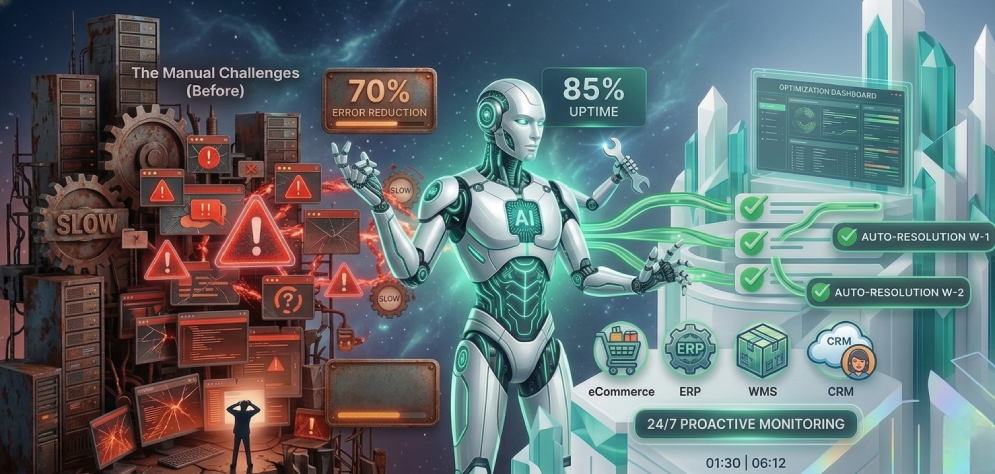
This is the inflection point where intelligent automation stops being a nice-to-have and becomes a strategic necessity. In this case study, we explore how Aigentora.ai partnered with Patchworks — a leading integration platform connecting eCommerce, ERP, WMS, and CRM systems — to replace a manual, reactive error management process with a fully automated, AI-driven monitoring and resolution framework. The result was a 70% reduction in manual error triaging and an 85% improvement in system uptime and reliability.

🏢 Client Overview: Patchworks
Patchworks is a leading integration platform designed to enable fast, scalable connections between the core technology systems that power modern commerce. Their platform connects eCommerce engines such as Shopify, BigCommerce, and Adobe Commerce with ERP systems, warehouse management platforms, CRM tools, and retail infrastructure — enabling seamless data flow across the entire commerce stack.
As a platform built on connectivity, Patchworks’ value proposition depends entirely on uptime, reliability, and speed. When integrations fail — and in complex multi-system environments, they inevitably do — the business impact is immediate and measurable: delayed orders, incorrect inventory data, failed payments, and frustrated clients.
As their client base grew, so did the operational complexity of managing these integration environments. What had once been a manageable volume of errors requiring manual investigation had become an unsustainable operational burden — one that demanded a fundamentally different approach.
⚡ The Challenges: When Scale Breaks Manual Processes
The challenges Patchworks faced were not unusual — they are the inevitable consequence of success in the integration platform space. As more clients came onboard, more systems were connected, and more data flowed through the platform, the failure surface area expanded accordingly. The support team was overwhelmed not by incompetence but by volume.
📊 Challenge 1: Manual Monitoring at Scale
With high volumes of integration errors arriving continuously across dozens of client environments, the support team was required to manually review logs, identify error patterns, and determine root causes for each issue. This was not only time-consuming but also highly error-prone — humans are not well-suited to pattern recognition across large, noisy data sets at speed.
🔁 Challenge 2: Repetitive Diagnostics Draining Resources
A significant proportion of errors were recurring — the same categories of failures appearing repeatedly across similar integration configurations. Despite this, each occurrence required a fresh manual investigation. There was no mechanism to recognize a known error type and apply an established resolution automatically. The same diagnostic work was being performed over and over by skilled engineers whose time would have been far better spent on novel, complex issues.
🔍 Challenge 3: Slow Root Cause Analysis Across Multiple Systems
Modern integration errors rarely have a single, obvious cause. A failure at the eCommerce layer might originate from an ERP configuration change, a WMS API rate limit, or a CRM schema update. Tracing the root cause across multiple interconnected systems required deep expertise and significant time — delaying resolution and prolonging client impact.
🧑💻 Challenge 4: Human-Dependent Resolution Workflows
Every resolution step in the existing workflow required human sign-off, even for well-understood, low-risk corrective actions. This dependency created bottlenecks, particularly during off-hours or peak periods when support team availability was constrained. The system had no capacity to heal itself — every fix required a human in the loop.
📈 Challenge 5: Growing Client Base, Growing Pressure
As Patchworks continued to acquire new clients and expand its integration offerings, the operational pressure on the support team increased proportionally. Without a scalable solution, each new client effectively added more manual work to an already strained team. The business needed a model where operational capacity could grow without a corresponding linear increase in headcount.
🎯 The Objective: Building a Self-Healing Integration Platform
Patchworks’ goals for this engagement were clear and ambitious. They needed a solution that would:
- Automate error detection and intelligent classification across all integration environments.
- Deploy automated alerting via Email, Slack, and messaging platforms for real-time visibility.
- Dramatically reduce the support workload associated with repetitive, recurring diagnostics.
- Improve response time for issue identification and resolution — from hours to minutes.
- Increase system reliability and uptime across all client integration environments.
- Build a scalable AI-driven monitoring framework capable of growing alongside the client base.
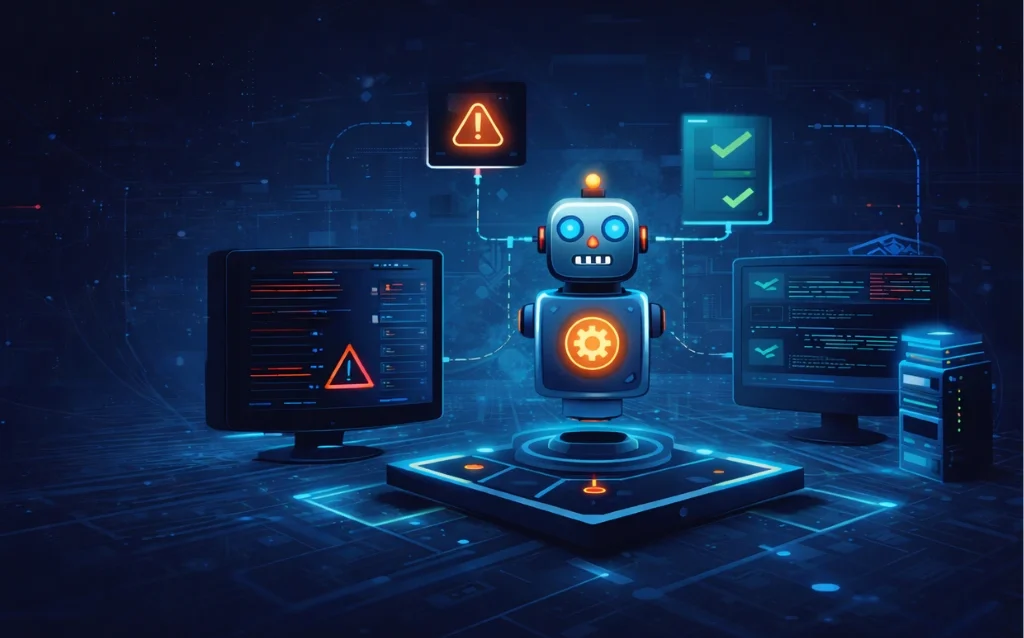
The underlying philosophy was a shift from reactive troubleshooting — finding and fixing errors after they occur — to proactive system intelligence — anticipating, categorizing, and resolving issues before they escalate into client-impacting incidents.
Aigentora.ai designed and deployed a comprehensive AI-powered automation framework tailored specifically to Patchworks’ integration ecosystem. The solution comprised five tightly integrated components, each addressing a specific dimension of the error management challenge.
🤖 1. Intelligent Error Classification Engine AI models analyzed logs, API responses, and real-time integration data to automatically categorize every error by type, severity, and root cause probability. Instead of a human engineer reading through raw log files, the classification engine processed thousands of events per minute — surfacing the errors that mattered, labeling them accurately, and prioritizing them for attention or automated resolution. |
⚙️ 2. Automated Diagnostic Workflows Pre-built resolution logic triggered contextual workflows based on error type, eliminating manual investigation for all recurring issues. When the classification engine identified a known error pattern, the diagnostic workflow activated automatically — executing the appropriate diagnostic sequence, gathering relevant context, and preparing the system for resolution without any human involvement. |
💡 3. AI-Based Recommendation System For novel or complex errors that fell outside the automated resolution scope, the system generated intelligent recommendations — suggesting resolution steps, configuration adjustments, or retry protocols based on historical patterns from similar incidents. Support engineers received not just an alert but a prioritized, context-rich action plan, dramatically reducing the cognitive load of manual diagnosis. |
📡 4. Real-Time Monitoring Dashboard A centralized interface provided live visibility into the health of every integration environment — showing performance metrics, error rates, automated fix status, and resolution outcomes in a single, unified view. Support teams could see at a glance which systems were healthy, which were being actively remediated by AI, and which required human attention. |
🔧 5. Auto-Resolution Mechanisms For predefined, well-understood error scenarios, the system executed corrective actions entirely without human involvement — retrying failed API calls, resetting connection states, clearing queues, or triggering fallback workflows automatically. These auto-resolutions operated 24/7, including nights, weekends, and peak periods when human availability was limited. |
🧰 Technology Stack
Layer | Technology |
AI & ML | Python, LLM APIs, Custom Classification Models |
Automation | n8n, REST APIs, Webhooks |
Database | PostgreSQL, Redis |
Infrastructure | Docker, AWS, CI/CD Pipelines |
Monitoring | Real-Time Logging & Alerting Systems |
💬 In Their Own Words
“Aigentora helped us transform a complex, manual error management process into a fully automated AI-driven system. Their team understood our technical challenges immediately and delivered a scalable solution that significantly reduced response times and operational overhead. The impact on our efficiency and platform reliability has been substantial.” — David Wiltshire | eCommerce Entrepreneur & Growth Specialist, Patchworks (By Cogent2) |
📊 Results & Impact: The Numbers Behind the Transformation
The results of the AI automation framework were both immediate and sustained. Patchworks transitioned from a reactive, human-dependent error management model to a proactive, AI-driven system intelligence framework — with measurable improvements across every key operational metric.
📉 70% Reduction in Manual Error Triaging
The most direct measure of success: seven out of every ten error events that previously required manual investigation are now handled entirely by the AI classification and resolution system. Support engineers are no longer spending their days reading log files and investigating recurring issues — they focus exclusively on genuinely novel, complex incidents that require human expertise.
✅ 85% Improvement in System Uptime and Reliability
By detecting and resolving errors faster — often before they escalate into client-impacting incidents — the platform achieved an 85% improvement in overall system uptime and reliability. Auto-resolution mechanisms operating around the clock meant that many issues were corrected within seconds of detection, rather than sitting unresolved until a human engineer was available to address them.
🔔 Automated Multi-Channel Alerting
The deployment of automated Email, Slack, and messaging alerts ensured that the right people were notified of the right issues at the right time — without anyone having to manually monitor dashboards or log files. Critical alerts reached support teams instantly, with full context attached, enabling rapid response for the minority of issues that required human attention.
⚡ Faster Issue Identification and Resolution
The time from error occurrence to identification dropped from minutes or hours to seconds. The time from identification to resolution — for automated scenarios — dropped to near-zero. For escalated issues, support engineers received pre-analyzed, contextualized alerts that eliminated the initial diagnostic phase entirely, compressing resolution timelines significantly.
🚀 Reduced Operational Load and Improved Scalability
Perhaps the most strategically significant outcome was the decoupling of operational load from client volume. Under the previous model, each new client added proportional manual work to the support team. Under the new AI-driven model, the automated framework absorbs the majority of that additional load — meaning Patchworks can continue scaling its client base without a corresponding linear increase in support headcount.
📊 Results at a Glance
70% Reduction in manual error triaging | 85% Improved system uptime & reliability | 24/7 Automated monitoring & auto-resolution |
🔄 Before vs. After: The Transformation in Detail
Area | Before (Manual) | After (AI-Driven) |
Error Detection | Manual log review | Automated real-time classification |
Root Cause Analysis | Hours of manual tracing | Instant AI-powered diagnosis |
Resolution | Human intervention required | Auto-resolution for known scenarios |
Alerting | No automated alerts | Email, Slack & message automation |
Scalability | Limited by headcount | Scales with client volume |
Uptime | Reactive, slow recovery | Proactive, near-instant recovery |
Support Load | High & growing | Reduced by 70% |
💡 Key Takeaways for Enterprise Platforms
The Patchworks engagement offers a clear blueprint for any integration platform, SaaS provider, or enterprise technology team wrestling with the challenge of managing errors at scale. The lessons are broadly applicable:
- Manual monitoring does not scale. As system complexity grows, the only sustainable path is intelligent automation. Human engineers are too valuable to spend their time on repetitive log analysis.
- Classification is the foundation of automation. Before you can automate resolution, you need to reliably classify errors. Investing in a robust classification engine unlocks everything downstream.
- Not all errors need human attention. A well-designed auto-resolution system can handle the majority of known, low-risk error scenarios without any human involvement — freeing engineers for genuine problem-solving.
- Real-time alerting changes the game. The difference between knowing about an error in seconds versus hours is the difference between a minor hiccup and a major client incident. Automated, multi-channel alerting is non-negotiable at scale.
- AI-driven operations decouple growth from headcount. The most strategically valuable outcome of this engagement was proving that Patchworks could scale its client base without scaling its support team proportionally.
🏁 Conclusion: The Age of Proactive System Intelligence
The shift from reactive to proactive operations is not a luxury — it is an inevitability for any platform that intends to scale. The question is not whether AI will take over the monitoring and resolution of integration errors; it is whether your organization will make that transition on its own terms or under the pressure of a system that has grown too complex to manage manually.
Patchworks made that transition deliberately, with Aigentora.ai as their technical partner. The result was not just better metrics — it was a fundamentally different operating model. One where the platform monitors itself, heals itself, and alerts humans only when genuinely novel situations demand their expertise.
For integration platforms, SaaS providers, and enterprise technology teams operating at scale, the message is clear: the era of reactive troubleshooting is over. The future belongs to platforms intelligent enough to know what is wrong before the client does — and fix it before they ever notice.
Aigentora.ai builds AI-driven automation frameworks for enterprise platforms.
💡 Frequently Asked Questions
AI-driven error detection uses machine learning models to automatically analyze system logs, API responses, and integration data in real time. Instead of a human engineer manually reviewing failures, the AI classifies each error by type, severity, and root cause probability within seconds. This enables faster response and eliminates the delays associated with manual monitoring.
Traditional support workflows require a human engineer to investigate, diagnose, and resolve every error — even recurring, well-understood ones. Automated resolution uses pre-built AI logic to detect known error patterns and execute corrective actions instantly without any human involvement. This reduces resolution time from hours to seconds for the majority of common integration failures.
AI auto-resolution works best for recurring, predictable error scenarios such as failed API retries, connection timeouts, queue backlogs, and configuration mismatches. These predefined scenarios are mapped to automated corrective actions that the system executes immediately upon detection. Complex or novel errors are escalated to human engineers with full diagnostic context already attached.
AI improves uptime by detecting and resolving errors before they escalate into client-impacting incidents. Because the system monitors continuously and acts within seconds of detection, many failures are corrected before any client ever notices a disruption. This proactive approach is far more effective than reactive troubleshooting, which only begins after the damage is already done.
Multi-channel alerting automatically sends error notifications via Email, Slack, and messaging platforms the moment an issue is detected. This ensures the right people are informed instantly with full context — eliminating the need for anyone to manually monitor dashboards or log files. Faster awareness directly translates into faster response and shorter resolution windows.
Large Language Models (LLMs) power the intelligent classification and recommendation layers of the system. They analyze unstructured log data, identify patterns across historical incidents, and generate human-readable resolution recommendations for support engineers. LLMs bring a level of contextual understanding to error diagnosis that traditional rule-based systems simply cannot replicate.
AI automation decouples operational workload from client volume — meaning the platform can onboard new clients without a proportional increase in support headcount. The automated framework absorbs the majority of routine error handling, keeping the support team’s workload manageable regardless of how many clients are connected. This is the key to sustainable, cost-efficient growth for integration platforms.
Implementation timelines vary based on the complexity of the integration environment, the number of connected systems, and the volume of historical error data available for model training. A well-scoped engagement with a clear technical brief can typically deliver a functional automated monitoring layer within weeks. Full auto-resolution capabilities are deployed iteratively as error patterns are validated and resolution logic is refined.
Yes — enterprise-grade AI error management frameworks are built with security as a core requirement, not an afterthought. Data is processed within secure infrastructure (such as AWS), access is role-controlled, and sensitive log data is handled in compliance with applicable data governance policies. The system operates entirely within the client’s existing security perimeter.
Any business operating a multi-system integration environment — eCommerce platforms, ERP-connected retailers, SaaS providers, logistics companies, and enterprise technology teams — stands to benefit significantly. The value is highest for organizations processing high transaction volumes, serving multiple clients simultaneously, or operating integrations across many different technology stacks. If your support team spends significant time on repetitive error diagnosis, AI automation will deliver immediate and measurable ROI.