
Something unusual is happening inside modern businesses.
Work is getting done faster. Operations are smoother. Teams are more productive.
But here’s the catch — no one new has been hired.
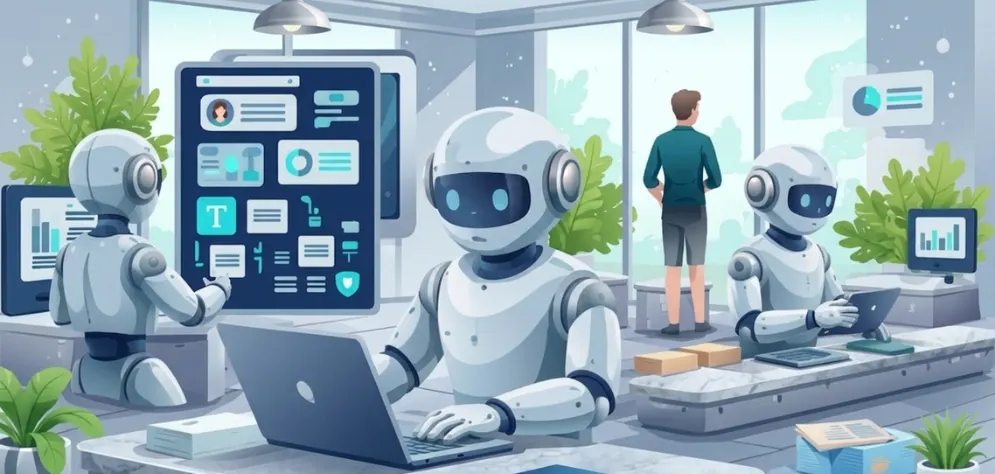
Welcome to the era of the silent workforce — AI agents that are quietly taking over repetitive tasks behind the scenes.
Unlike traditional automation or basic AI tools, these agents don’t just assist — they act, decide, and execute. And the biggest shift? Most businesses don’t even realize how much work has already been offloaded.
In this article, we’ll break down:
- What AI agents really are
- How they’re replacing repetitive work
- Where they create the biggest impact
- And how you can start using them in your business
🧠 What Is the “Silent Workforce”?
The “silent workforce” refers to AI agents working in the background, handling tasks that previously required human effort.
These are not just chatbots or scripts.
They are:
- Autonomous
- Context-aware
- Task-oriented
- Continuously improving
👉 Think of them as digital employees that never sleep, never slow down, and never complain.
🔄 From Automation to AI Agents: What Changed?
Traditional automation has been around for years — but it had limitations.
| Feature | Traditional Automation | AI Agents |
|---|---|---|
| Flexibility | Rule-based | Adaptive & intelligent |
| Decision-making | None | Context-aware decisions |
| Learning ability | Static | Continuously improves |
| Scope | Single task | Multi-step workflows |
| Human dependency | High | Low |
👉 The shift is simple:
Automation follows rules.
AI agents understand outcomes.
⚙️ Where AI Agents Are Quietly Replacing Work
AI agents are not replacing entire jobs overnight — instead, they are eliminating repetitive layers of work inside roles.
Here’s where they’re already making an impact:
💬 Customer Support
- Answering FAQs instantly
- Handling repetitive queries
- Routing complex issues
Result:
Support teams focus only on high-value conversations.

🛒 E-commerce Operations
- Product tagging
- Inventory updates
- Order processing workflows
Result:
Scalable systems without increasing team size.
🏢 Internal Workflows
- Task assignments
- Status tracking
- Reporting
Result:
Operations run without constant human supervision.
📣 Marketing Operations
- Generating content drafts
- Scheduling campaigns
- Analyzing performance data
Result:
Faster execution with fewer resources.
📊 Data Entry & Processing
- Extracting data from emails, PDFs, forms
- Updating CRM systems automatically
- Cleaning and structuring data
Result:
Hours of manual work reduced to seconds.
Here’s the interesting part:
AI agents don’t create disruption — they create absence of friction.
That’s why they go unnoticed.
Instead of dramatic change, you see:
- Fewer delays
- Less manual work
- Faster outcomes
👉 Work doesn’t “feel” replaced — it just disappears.
🚀 Benefits of the Silent Workforce
⏱️ Massive Time Savings
Tasks that took hours now take minutes (or seconds).
💰 Cost Efficiency
Reduce dependency on repetitive roles without compromising output.
🌍 24/7 Productivity
AI agents don’t stop — your operations keep running.
📈 Scalability Without Hiring
Grow output without growing team size.
🎯 Focus on High-Value Work
Humans shift from execution → strategy.
📖 A Practical Example
Let’s say a business handles 500 customer inquiries daily.
Before AI Agents:
- 3 support executives
- Delays in response
- Repetitive queries handled manually
After AI Agents:
- 80% queries handled automatically
- Instant responses
- Team focuses only on complex cases
👉 Outcome:
- Faster support
- Lower cost
- Better customer experience
❗ Common Misconceptions About AI Agents
❌ “AI will replace all jobs”
👉 Reality: It replaces tasks, not entire roles.
❌ “It’s only for large companies”
👉 Reality: Small teams benefit the most.
❌ “It’s complicated to implement”
👉 Reality: With the right setup, it’s faster than hiring.
🛠️ How to Start Using AI Agents in Your Business
You don’t need to transform everything overnight.
Start small.
Step 1: Identify Repetitive Tasks
Look for:
- Manual data entry
- Repeated customer queries
- Routine workflows
Step 2: Prioritize High-Impact Areas
Focus on tasks that:
- Consume time
- Don’t require creativity
- Follow patterns
Step 3: Implement One AI Agent
Start with a single workflow:
- Customer support
- Lead qualification
- Content generation
Step 4: Expand Gradually
Once you see results, scale to:
- Multiple workflows
- Cross-functional automation
📊 AI Agent Use Cases by Business Function
| Business Function | Repetitive Tasks | AI Agent Role | Impact |
|---|---|---|---|
| Customer Support | Answering FAQs, ticket routing | Automated response + smart routing | Faster response time, reduced workload |
| Sales | Lead qualification, follow-ups | Lead scoring + automated outreach | Higher conversion rates |
| Marketing | Content drafting, campaign scheduling | Content generation + optimization | Consistent output, time savings |
| Operations | Task tracking, reporting | Workflow automation + status updates | Improved efficiency |
| HR | Resume screening, interview scheduling | Candidate filtering + scheduling | Faster hiring process |
| Finance | Invoice processing, data entry | Data extraction + validation | Reduced errors, faster processing |
| E-commerce | Product tagging, order updates | Catalog automation + order workflows | Scalable operations |
🔮 The Future: Invisible Operations
We are moving toward a world where:
- Businesses run on autonomous systems
- Teams focus only on decision-making and growth
- Operations become invisible but powerful
👉 The companies that adopt early will have a massive advantage.
🧾 Final Thoughts
The biggest transformation in business today isn’t loud.
It’s silent.
AI agents are not just tools — they are becoming a workforce layer that operates quietly, efficiently, and endlessly.
And the question is no longer:
“Should you adopt AI?”
It’s:
“How much work is already being replaced without you noticing?”
Start automating your business with AI agents that actually work — not just assist.
💡 Frequently Asked Questions
AI agents are intelligent systems that can perform tasks, make decisions, and complete workflows without constant human input. Unlike basic tools, they understand context and act accordingly, functioning like digital employees working in the background.
Traditional automation follows fixed rules and handles simple tasks, while AI agents adapt, learn, and make decisions based on data and context. They can manage multi-step workflows instead of just executing predefined actions.
AI agents mainly replace repetitive and time-consuming tasks rather than entire jobs. Humans remain essential for creativity, strategy, and complex decision-making, making AI a tool for enhancement rather than replacement.
AI agents can handle customer support, data entry, content creation, and workflow management. They are especially useful for repetitive and rule-based processes, helping teams save time and increase efficiency.
No, AI agents are highly valuable for small and medium businesses as well. They allow smaller teams to scale operations, improve productivity, and compete with larger organizations without hiring more staff.
The cost of implementing AI agents varies depending on complexity, but many solutions are affordable and scalable. In most cases, the time and cost savings they generate outweigh the initial investment.
Businesses can start using AI agents within days or weeks depending on the use case. Simple workflows like customer support or data automation can be implemented quickly with the right tools.
Not necessarily, as many modern AI tools are designed with user-friendly interfaces. However, more advanced implementations may require technical expertise or support from AI specialists.
Yes, when implemented correctly, AI agents can be secure and reliable. Businesses should follow best practices like data protection, access control, and regular monitoring to ensure safe usage.
AI agents will become a core part of business operations, handling more complex and strategic workflows. As technology evolves, they will enable faster decision-making, greater efficiency, and scalable growth.