
Artificial Intelligence is no longer experimental — it’s a core business advantage. From intelligent chatbots to automated workflows and AI agents, companies are rapidly adopting Large Language Models (LLMs) to improve efficiency, customer experience, and decision-making.
But one major question remains:
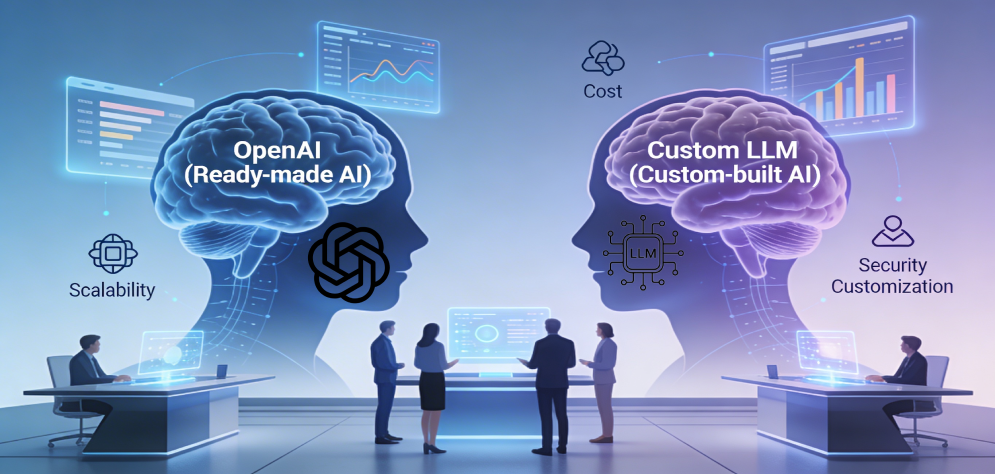
 Should your business use OpenAI’s models or build a custom LLM?
In this detailed guide, we’ll break down everything you need to know — including cost, scalability, security, performance, flexibility, and real-world use cases — so you can confidently choose the right solution for your business.
⚙️ What Is OpenAI?
OpenAI is one of the world’s leading artificial intelligence companies, known for developing advanced language models like:
ChatGPT
GPT-4
GPT-4o
These models are accessible via APIs, allowing businesses to integrate AI into websites, apps, CRMs, support systems, and internal tools without building models from scratch.
Key Benefits of OpenAI
No infrastructure setup required
State-of-the-art accuracy
Fast deployment
Continuous model improvements
Scalable API access
Multimodal capabilities (text, image, voice)
OpenAI works especially well for businesses that want speed, reliability, and minimal technical complexity.
🧠 What Is a Custom LLM?
A Custom LLM is a language model that is:
Built from scratch
Fine-tuned on proprietary data
Hosted privately (cloud or on-premise)
Fully controlled by the organization
Companies may use open-source models (like LLaMA, Mistral, etc.) and train or fine-tune them based on specific industry requirements.
Custom LLMs are typically chosen by enterprises that require:
Strict data privacy
Industry-specific language adaptation
Full model ownership
Offline or on-premise deployment
⚖️ OpenAI vs Custom LLM: Detailed Comparison
1. Development Time
OpenAI :
Ready-to-use API
Can deploy within days
No AI research team required
Custom LLM :
Requires AI engineers and infrastructure
Model training + testing may take months
High experimentation effort
Winner for Speed: OpenAI
2. Cost Comparison
OpenAI :
Pay-as-you-use pricing
No hardware investment
Lower upfront cost
Custom LLM :
High GPU infrastructure cost
Engineering team salaries
Ongoing maintenance
For startups and SMBs, OpenAI is usually far more cost-effective. Custom LLMs make financial sense only at very large scale.
Winner for Budget-Friendly Setup: OpenAI
3. Data Privacy & Control
OpenAI :
Enterprise-grade security
SOC 2 compliant
API-based processing
However, data is processed through external infrastructure.
Custom LLM :
Full control over data
On-premise hosting possible
Ideal for healthcare, defense, finance sectors
Winner for Maximum Control: Custom LLM
4. Customization & Industry Specialization
OpenAI :
Supports fine-tuning
Prompt engineering flexibility
RAG (Retrieval-Augmented Generation) integration
Custom LLM :
Fully trainable on internal datasets
Can specialize deeply in medical, legal, or financial domains
Complete architecture customization
Winner for Deep Customization: Custom LLM
5. Performance & Model Quality
OpenAI models are trained on massive datasets with advanced reinforcement learning techniques.
Custom LLM performance depends heavily on:
Training data quality
GPU budget
Engineering expertise
In most cases, OpenAI delivers superior general performance.
Winner for Overall Performance: OpenAI
6. Scalability
OpenAI :
Cloud-based auto-scaling
Handles millions of requests
No DevOps stress
Custom LLM :
Requires scaling GPU clusters
Infrastructure complexity
Maintenance overhead
Winner for Effortless Scaling: OpenAI
🏢 When Should You Choose OpenAI?
Choose OpenAI if:
You want fast AI deployment
You don’t have an in-house AI research team
You need reliable, high-performing AI
You’re building chatbots, AI agents, automation tools
You want lower upfront investment
It’s ideal for SaaS companies, eCommerce brands, startups, and mid-size enterprises.
🏛️ When Should You Choose a Custom LLM?
Choose Custom LLM if:
You operate in a highly regulated industry
You require full data isolation
You need deep industry specialization
You have a dedicated AI engineering team
You want full model ownership
Large enterprises and government organizations often prefer this route.
🔄 Hybrid Approach: The Smart Middle Ground
Many businesses now adopt a Hybrid AI Strategy:
Use OpenAI for general intelligence tasks
Use custom models for sensitive or specialized workflows
Implement RAG systems for private data integration
This approach balances cost, performance, and control.
📌 Real-World Use Case Examples
See practical examples of how businesses implement each solution.
1. SaaS Startup
Uses OpenAI API to power:
Customer support AI
AI onboarding assistant
Automated report generation

2. Healthcare Enterprise
Builds Custom LLM:
Trained on medical terminology
Hosted on private servers
HIPAA-compliant deployment
3. FinTech Platform
Hybrid approach:
OpenAI for customer interaction
Custom model for internal risk analysis
🆚 Decision Framework: Quick Comparison Table
| Factor | OpenAI | Custom LLM |
|---|---|---|
| Setup Time | Fast | Slow |
| Upfront Cost | Low | High |
| Maintenance | Minimal | Complex |
| Data Control | Moderate | Full |
| Scalability | Easy | Complex |
| Customization Depth | Medium | High |
| Best For | Startups, SaaS | Enterprises |
📝 Final Verdict: Which Is Better?
There is no one-size-fits-all answer.
If your goal is speed, cost-efficiency, and performance, OpenAI is the better choice.
If your priority is data sovereignty, deep customization, and ownership, a Custom LLM is the better long-term solution.
For most businesses in 2026, OpenAI + smart integration strategy delivers the best ROI.
🔎 Conclusion
Choosing between OpenAI and a Custom LLM depends on your:
Budget
Industry regulations
Technical expertise
Scalability needs
Long-term AI vision
Before deciding, conduct a technical and financial feasibility analysis.
If you’re unsure which path suits your business model, consider starting with OpenAI and scaling toward a hybrid or custom solution as your AI maturity grows.
💡 Frequently Asked Questions
OpenAI provides ready-to-use AI models through APIs, allowing businesses to integrate AI quickly without building their own infrastructure. A Custom LLM, on the other hand, is developed or fine-tuned specifically for a business using proprietary data. It offers full control but requires more time, cost, and technical expertise.
OpenAI is generally more cost-effective for startups and small to mid-sized businesses because it operates on a pay-as-you-use model. Custom LLMs require significant investment in GPUs, AI engineers, and maintenance. Large enterprises with high usage may benefit from custom models long-term.
Yes, OpenAI provides enterprise-grade security and compliance standards suitable for most businesses. However, data is processed via external infrastructure, which may be a concern for highly regulated industries. Companies with strict data policies may prefer private deployments or custom models.
A business should choose a Custom LLM when it needs complete control over data, deep industry-specific training, or on-premise deployment. This is common in sectors like healthcare, finance, and government. It’s also suitable for companies with dedicated AI teams and long-term AI strategies.
Yes, OpenAI models can be customized using prompt engineering, fine-tuning, and retrieval-based systems (RAG). Businesses can integrate internal knowledge bases and workflows. While not as flexible as fully custom models, it still supports strong personalization.
OpenAI integration can be completed within days or weeks depending on the project complexity. Custom LLM development can take several months due to data preparation, training, testing, and deployment. Implementation time also depends on team expertise and infrastructure.
OpenAI generally delivers higher performance out of the box due to massive training data and continuous improvements. Custom LLM performance depends heavily on training quality and resources. For general business use, OpenAI often performs better initially.
Yes, many companies adopt a hybrid AI approach using OpenAI for general tasks and custom models for sensitive operations. This strategy balances cost, performance, and data control. It also allows businesses to scale AI gradually.
No, you don’t need a full AI research team to use OpenAI APIs. Developers can integrate AI into websites, apps, and automation tools easily. However, having AI consultants or developers helps optimize usage and results.
Yes, a Custom LLM offers maximum data privacy because it can be hosted on private servers or secure cloud environments. Businesses have full control over training data and outputs. This makes it ideal for handling confidential or regulated data.