
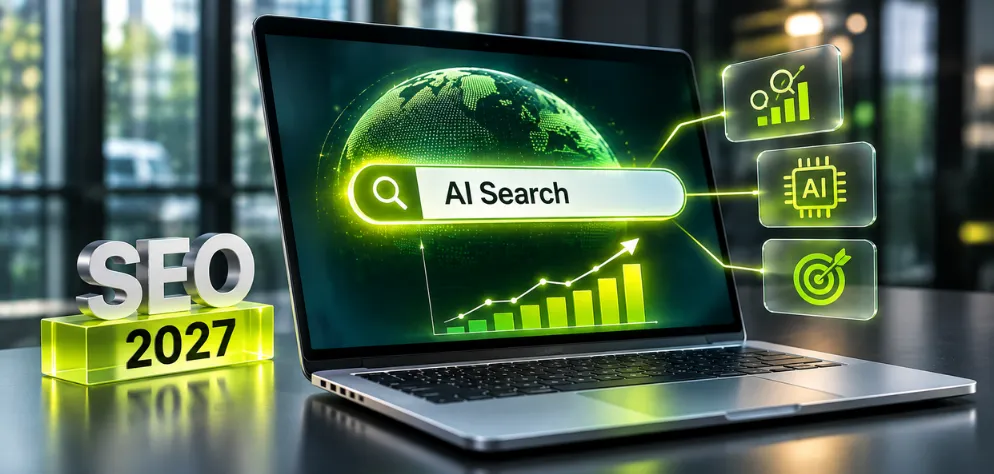
Short answerAI search turns results pages into answers. Fewer people click through, but the sources an answer cites get seen and trusted. In 2027, win by being the clearest, most credible source on your topic, and measure mentions and citations as well as rankings.
Same search, two very different results pages.
From ten blue links to answers that act
Drag the lever through the eras and watch the results page rebuild itself.
Where do the clicks go?
Studies report that AI answers cut clicks to websites. Try a what-if model for your own traffic. Nothing here is a forecast for your site.
One question becomes five searches
Google describes AI search features as breaking a question into related searches and combining what they find. That is why one page can be cited for a question you never targeted.
Make your page easy to quote
AI answers lift clear, specific passages. Switch on each fix and watch a weak block become one an assistant could quote.
Decide which crawlers get in
Search-style bots can make you visible in AI answers. Training bots are a business choice. Flip the switches and copy the result.
Inside a page AI can trust
Scan the page, then tap the pins. None of these needs a special AI trick. They are clear writing and honest signals.
Your scoreboard needs new columns
Rankings and sessions still matter. Add the numbers that show whether AI answers know, cite and send people to you.
Seven stops to AI-search ready
Ride the line from audit to monthly habit. Tap a station for the action.
Scratch off five AI-SEO myths
There is a lot of hype around AI search. Scratch each card, or press Reveal, to see what the evidence says.
Pick your first 90 days
Click the stickers you want to do. Quick wins land at the top of your plan.
- Your plan is empty.
Ready to be the answer AI quotes?
We review how your site shows up in Google, ChatGPT and other AI search tools, then build a practical plan: fixes, content, bot policy and the right KPIs.
Illustrative receipt. Your real audit scope is agreed with our team.
Frequently asked questions about AI search and SEO
Click a question and watch the answer stream in.
AI search is a way of finding information where a system such as Google’s AI Overviews and AI Mode, ChatGPT search or Perplexity writes an answer and cites sources, instead of only listing links. It often combines several searches behind the scenes.
No. AI answers still draw on search indexes and on pages that are crawlable, clear and trusted. What changes is the goal: you now compete to be cited and remembered, not only to rank and get a click.
SEO aims to rank pages in search results. GEO (generative engine optimization) and AEO (answer engine optimization) aim to get your content used and cited in AI answers. In practice they share the same foundations: helpful content, technical health and credibility.
Publish pages that answer a specific question clearly near the top, back claims with named sources, keep them updated, make them crawlable and build real mentions and reviews elsewhere. No guaranteed trick exists, and results vary by engine and topic.
It depends on the crawler. Search-style bots such as OAI-SearchBot or PerplexityBot can help you appear in answers, while training bots such as GPTBot or ClaudeBot are a business choice. Do not block Googlebot or Bingbot unless you want to leave those search engines.
Not that anyone can prove. Google has said it does not use llms.txt, and studies of crawler logs found very little bot interest. It is harmless to publish, but spend your time on content quality and technical basics first.
Pick 20 to 50 questions your customers ask, test them in AI search tools each month and record whether you are cited or mentioned, and who is. Add AI referral traffic in analytics, branded search demand and assisted conversions.
Studies report fewer clicks when an AI answer appears, especially for informational queries, while branded, local and high-intent searches hold up better. Expect some loss on simple questions and plan for visibility that does not depend on clicks.
Structured data helps search engines understand your pages and can earn rich results. Evidence that it directly raises AI citations is weak, so use it to describe content accurately and do not treat it as a shortcut.
Technical fixes and refreshed pages can show up within weeks, while earning mentions, reviews and authority usually takes months. Track monthly and judge the trend over a quarter or more.