

Every shipment. Every vendor. Zero chasing.
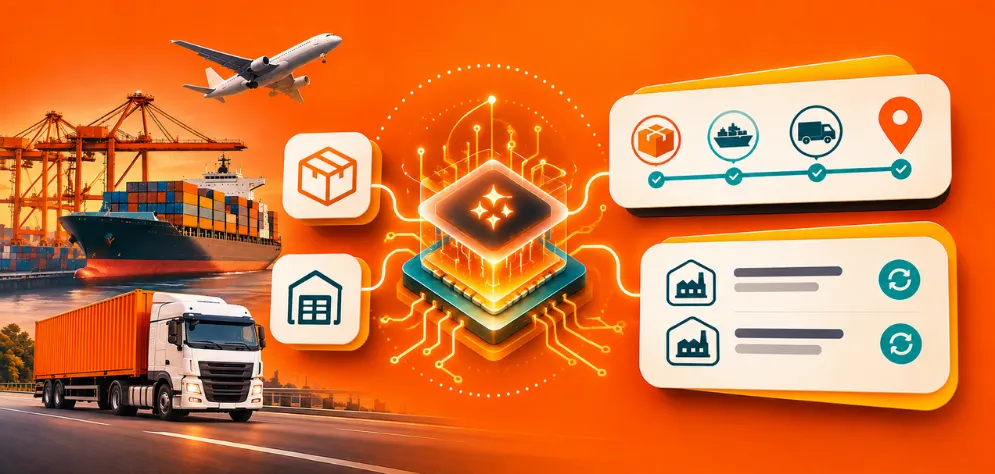
AI agents now watch carriers, ports and vendor inboxes for you, update your systems, warn customers before they ask, and chase late suppliers automatically. Here's how it works and how to start.
"Where's my shipment?" ×100 a day
Shipment data lives in a dozen places: carrier websites, forwarder emails, vendor WhatsApp chats, port notices and a spreadsheet someone updates on Fridays. So your logistics team becomes a human search engine, checking portals and copy-pasting updates all day.
Customers feel it too. In one analysis by DigitalGenius, about one in five customer support conversations was a "where is my order?" question.
What is an AI logistics agent?
An AI logistics agent is software that watches every shipment and supplier for you. It reads updates from carriers, ports and vendor emails, works out what they mean for your orders, and takes the routine next step itself: updating systems, informing people and chasing what's late. Your team only steps in for real decisions.
Pulls status from carrier APIs, tracking pages, port and vessel data, EDI feeds and vendor inboxes, around the clock.
Reads messy emails and PDFs, matches each update to the right PO, order and customer, and predicts a realistic ETA.
Updates your ERP or TMS, warns customers before they ask, chases silent vendors and escalates real problems to a person.
Not just a tracking page: a tracking page shows one carrier's status. An agent connects every source to your orders and does something about it.
From raw update to done, on autopilot
Every status update travels down the same six-station line. Scroll to run the conveyor.
Gathers updates from carrier APIs, tracking pages, vessel and port data, EDI and vendor emails.
APIs · EDI · inboxLinks each update to the right PO, sales order, SKU and customer, even when the email only mentions an invoice number.
ERP · order bookCalculates a realistic ETA from transit history, port waiting times and the carrier's own estimate.
history · live dataSpots delays, customs holds, missed pickups and missing scans before your customer does.
rules · anomaliesUpdates the ERP or TMS, messages the customer, emails the vendor or opens a ticket for your team.
email · WhatsApp · ERPCompares predictions with what actually happened, so the next ETA and alert is sharper.
feedback loopEvery shipment on one board
Sea, air and road, every carrier and forwarder, matched to your orders and kept current by the agent. No more logging into six portals. Hover a row to see what the agent knows.
Simulated board for illustration.
When things go wrong, the agent moves first
Most shipments are boring, and that's good. The value is in the 5–10% that aren't. Scroll to watch four common exceptions go from red to green.
Customs hold
Container held: certificate of origin missing
- Spots the "hold" status from the port feed within minutes
- Emails the vendor for the missing document, copies your broker
- Moves the ETA by two days and flags 3 affected orders
- Tells the customer before they ask
DetectedAgent actingResolved
Port congestion
Vessel waiting 3 days at anchorage
- Reads the vessel position and the port's waiting-time data
- Recalculates ETAs for every order on board
- Lists urgent SKUs and suggests air freight for the critical few
- Alerts sales so promises to customers stay honest
DetectedAgent actingResolved
Missed pickup
Truck didn't arrive at the vendor by cut-off
- Notices no pickup scan by the agreed time
- Checks with the carrier and requests the next available slot
- Updates the warehouse's inbound plan
- Logs the miss on the carrier's scorecard
DetectedAgent actingResolved
Temperature breach
Reefer container above its set point
- Picks up the sensor reading outside the allowed range
- Alerts your quality team and the carrier immediately
- Saves the readings as evidence for a claim
- Puts the stock on hold for inspection on arrival
DetectedAgent actingResolved
Illustrative scenarios. You decide which steps the agent may take alone and which need a person's approval.
Vendors reply however they like. The agent reads it all.
Suppliers send updates as emails, PDFs, WhatsApp notes or not at all. A language model reads each one, pulls out the facts, updates your systems and politely chases anyone who goes quiet. Open an envelope.
- PO4471
- Qty1,200 pcs
- Ready18 Nov
14 Nov - ReasonDyeing delay
- ✓ ERP date updated · 2 customers told
- PO8820
- Cartons14
- Shipped10 Nov · Air
- AWBRead from PDF
- ✓ Tracking linked · ASN sent to warehouse
- BookingBK-3391
- New ETD21 Nov
- CauseRolled (space)
- Orders hit6
- ✓ 6 orders re-dated · sales alerted
- PO9105
- Silent for5 days
- ActionPolite chase sent
- Reply3 h later: ships 13 Nov
- ✓ Escalates to buyer only if no reply in 48 h
Same desk. Different day.
What a logistics coordinator's day looks like before and after an agent takes over the chasing. Drag the handle.
With an AI agent
- 09:00Reads the overnight exception digest: 3 items need a decision
- 09:20Approves two re-routing suggestions with one click
- 10:00Calls one vendor about a real quality issue
- 11:00Plans next month's capacity with the carriers
- 14:00Negotiates rates using the carrier scorecards
- 18:00Status report has already gone out automatically
≈ 30 min of chasing · rest of the day on decisions
Without AI
- 09:00Logs into six carrier and forwarder portals
- 10:30Copies statuses into the shipment spreadsheet
- 11:30Answers 23 "where is it?" emails and calls
- 14:00Chases nine vendors for dispatch dates
- 16:00Finds a delay that started two days ago
- 18:30Builds the status report by hand, again
≈ 6 hours of chasing · problems found late
Illustrative schedule. Real savings depend on shipment volume and how many sources you connect.
Why 2026 is the year to automate the chasing
Analysts expect AI agents to become standard in supply chain software within a few years, and early adopters already see lower costs.
50%
of cross-functional supply chain solutions will use AI agents to make decisions on their own by 2030.
Gartner, May 2025
$53B
expected spend on supply chain software with agentic AI by 2030, up from under $2B in 2025.
Gartner, April 2026
5→60%
of companies using supply chain software with agentic AI features: 2025 vs Gartner's 2030 forecast.
Gartner, April 2026
5–20%
lower logistics costs from embedding AI in distribution operations.
McKinsey
20–30%
less inventory needed when AI is embedded in distribution operations.
McKinsey
1 in 5
customer support conversations were "where is my order?" questions in one analysis. Benchmarks vary widely.
DigitalGenius
Eight jobs to hand to an agent
Start with one, add the next when it works. Hover or tap a container to open its doors.
Tracks every sea, air and road shipment across carriers and predicts ETAs.
WinsOne live view; no portal hopping.
Shipment tracking & ETA
Reads vendor replies, updates PO dates and chases anyone who goes quiet.
WinsBuyers stop sending reminder emails.
Vendor PO follow-ups
Sends customers proactive updates and answers "where is it?" by chat or WhatsApp.
WinsFewer status tickets for support.
Customer delivery updates
Flags delays and damage, gathers evidence and drafts carrier claims.
WinsClaims filed on time with proof attached.
Exceptions & claims
Checks invoices, packing lists and certificates match before goods leave.
WinsFewer customs holds from paperwork errors.
Customs document checks
Scores carriers on on-time rate, damages and response speed, every week.
WinsRate talks backed by real data.
Carrier scorecards
Books and reschedules dock slots based on live ETAs.
WinsLess truck waiting, smoother receiving.
Dock appointment scheduling
Matches freight invoices to contracts, rates and actual shipments.
WinsOvercharges caught before you pay.
Freight invoice audit
It works with the tools you already use
No rip-and-replace. The agent plugs into your inboxes, chat apps, ERP and carriers through APIs, EDI or plain email, then keeps them in sync.
- Inner ring: where messages arrive
- Middle ring: your systems of record
- Outer ring: the outside world
Hover a system to see what the agent gets from it.
How much chasing could you switch off?
Plug in your own numbers. A "touch" is any manual status check, email, call or spreadsheet update for one shipment.
hours saved / month
Rough estimate: shipments × touches × minutes × automated share. Real results depend on your data sources and processes.
Live in 90 days, one bay at a time
Start small with one trade lane or vendor group, prove it, then load the next phase.
Connect & watch
- Connect carrier feeds, the shared inbox and your ERP
- Pick one lane or vendor group as the pilot
- Agent tracks and predicts ETAs; people still act
- Measure today's manual touches and status tickets
Automate updates
- Agent writes status and dates back to the ERP
- Proactive customer notifications switch on
- Vendor emails are read and auto-chased
- A person reviews anything the agent isn't sure about
Act on exceptions
- Exception playbooks with approval limits
- Daily digest instead of manual reports
- Compare touches, tickets and late surprises with day 1
- Roll out to the next lanes and vendors
Stop chasing shipments. Start managing exceptions.
Show us how updates reach your team today. We'll map where an agent saves the most time and what a 90-day pilot would look like. Free 30-minute call.
Questions we get about AI in logistics
It's software that collects shipment updates from every carrier, forwarder, port and vendor you work with, matches them to your orders, predicts realistic arrival times and alerts the right people when something slips. With an AI agent, it also takes routine next steps itself, like updating your ERP or messaging the customer.
A carrier's tracking page shows one shipment from one carrier. An AI agent combines all carriers and modes in one view, links each update to your purchase orders and customers, spots problems early and acts on them, so nobody has to check portals one by one.
Yes. Modern language models are good at pulling PO numbers, quantities, dates and reasons out of free-text emails, packing lists and invoices. Good systems also score their confidence and send anything unclear to a person for a quick check instead of guessing.
Usually: carrier and courier APIs, EDI from forwarders and 3PLs, shared email inboxes, WhatsApp Business, ERPs such as SAP, NetSuite, Odoo, Tally or Dynamics, your TMS or WMS, and spreadsheets. If a system has an API, an export or even just an email notification, it can normally be connected.
It depends on your data. Predictions improve as the system learns from your own lanes, carriers and ports, and they are usually more useful than a static carrier estimate because they update as conditions change. A good setup shows a confidence level rather than pretending to be certain.
No. It removes the repetitive chasing: checking portals, copying statuses and sending reminders. Coordinators spend that time on exceptions, carrier negotiations, planning and relationships, which is the work that actually needs people.
A focused pilot on one lane or vendor group can show results within the first month, and a typical rollout to automated updates and exception handling takes around 90 days. The main factors are how many systems you connect and how clean your order data is.
Cost depends on shipment volume, the number of integrations and how much the agent is allowed to do on its own. A pilot is a fixed, scoped project; running costs are mostly hosting and AI usage, which grow with volume. A short audit gives you a firm quote and an estimate of the hours saved.
It should be designed to be. Data can stay in your own cloud, connections use encrypted APIs and least-privilege access, every action the agent takes is logged, and you can choose AI models and providers that don't train on your data.
Pick one lane or vendor group that causes the most chasing. Connect its carrier feeds and the inbox where updates arrive, measure today's manual touches and status tickets, run a pilot and compare after 30 days. Aigentora can run this with you, starting with a free audit.