
A private LLM keeps your prompts, documents and answers inside infrastructure you control. Here is how it works, what it costs, and when it makes sense.
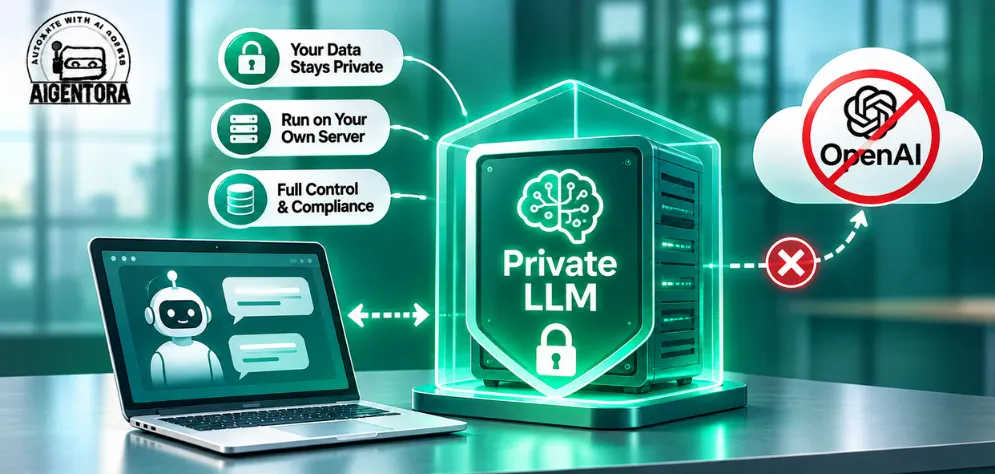
Short answerA private LLM is a language model that runs on infrastructure you control: your server, your cloud account or your workstation. Prompts, files and answers stay inside your network instead of travelling to a third-party API.
Follow one prompt, both ways
The model might be equally clever either way. What changes is who handles your words on the way.
Four kinds of data you may be sending out
Every AI request carries more than the question. Hover or tap a screen to see the same data in a private setup.
Whether a given provider stores or trains on this data depends on its current terms and your contract. Always read them.
Five units make a private LLM work
Power the rack on by scrolling. Hover a unit to see its job.
One bill climbs with use. The other stays flat.
Drag the usage slider. Change the prices to match real quotes.
Pay per token (API) METER RUNNING
Monthly bill at this usageOwn server FLAT RATE
Hosting per month, no matter the usageIllustrative numbers only. Use your provider’s current price and a real hosting quote. Privacy requirements can justify a private LLM even below break-even.
Build, then run a private AI workflow in n8n
Keep scrolling: the canvas assembles, then executes. Hover any node to inspect its sample output.
Output
Hover a node to inspect its data.
Sample data is illustrative. n8n’s Ollama nodes connect to a model server you host, so the whole flow can stay on your own infrastructure.
Push the faders. See the GPU you need.
Bigger models and more users at once need more GPU memory. Set your workload to get a starting point.
Rough planning estimate for 4-bit quantised open models. Real needs vary by model, context settings and serving software, so test before you buy hardware.
Four places to host it, drawn to scale
Choose a plan. Each trades control against effort and cost.
Five stamps before an answer is released
A private LLM is only as private as the controls around it. Every request should clear these checkpoints.
1. Network isolation
The model server has no route to the public internet. Outbound traffic is denied unless you allow it.
2. Access control
Single sign-on and roles decide who can ask what, and which documents each person’s questions can reach.
3. Encryption
Traffic is encrypted in transit. Model files, indexes and backups are encrypted at rest.
4. Audit logging
Record who asked what and when, while masking or excluding sensitive content from the logs.
5. Guardrails
Check inputs and outputs for prompt injection, leaked secrets and personal data before an answer is shown.
Documents a private LLM can read so nobody else does
Pick an industry, then move your cursor over the page to shine the flashlight on what stays inside your network.
All names and figures above are invented examples.
Is your business ready for a private LLM?
Flip every switch that is true for you and watch the needle.
Six mistakes that topple private LLM projects
Pull a block to see what goes wrong and how to prevent it. Careful, the tower leans.
Which one will you pull first?
Each block hides a mistake we see in real projects.
Ready to run AI on your own infrastructure?
Choose how you would host it and how big a model you need. We will plan the real build with you: model, hosting, retrieval and n8n workflows.
Frequently asked questions about private LLMs
Hover to turn the key. Click a box to open it.
It is as private as the environment around it. The model itself makes no outside calls, but you still need to block unwanted outbound traffic, review logs and check any plugins or tools you connect.
OpenAI states that business and API data is not used for training by default. Your data still leaves your environment and may be retained for a period. Terms change, so check the current policy and your contract.
Open-weight families such as Llama, Qwen, Mistral, Gemma and gpt-oss are popular. Licences differ on commercial use, so read each one before you deploy.
It depends on model size. Small 7 to 8B models fit on a GPU with around 8 GB of memory when quantised. A 70B model needs roughly 48 GB or more. Longer texts and more simultaneous users need extra headroom.
For focused tasks with good retrieval, mid-size open models perform very well. Frontier hosted models still lead on the hardest reasoning and open-ended work. Test both on your own examples.
You pay mainly for GPU hosting plus engineering time. That cost is mostly fixed, so it beats per-token pricing at high volume. At low volume an API is often cheaper, unless privacy rules decide it for you.
Usually not. Start with good prompts and retrieval over your documents. Fine-tuning helps when you need a consistent style or format that prompting cannot deliver.
Yes. n8n can be self-hosted and has AI nodes that work with local model servers such as Ollama. That keeps triggers, retrieval and the model inside your own environment.
No tool does that on its own. It gives you control over where data lives, which helps. You still need access controls, logging, retention rules and legal review for your situation.
A working pilot can take days. A production setup with retrieval, access control and monitoring usually takes several weeks, depending on data quality and hosting choices.