

AISEO for AI search · 2026 guide
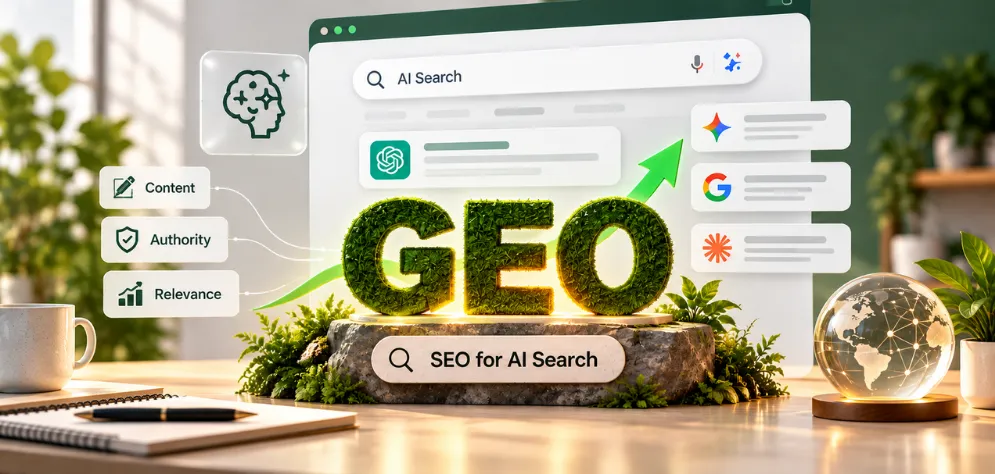
GEO is the practice of making your content and brand easy for AI answer engines to find, trust and cite. That includes ChatGPT, Google AI Overviews and AI Mode, Perplexity, Gemini and Claude. SEO earns you a spot in the list of links. GEO earns you a mention inside the answer itself.
01Definition
What is GEO, in plain words?
Generative Engine Optimization is the work of making your content the source AI engines quote. Instead of only competing for ten blue links, you compete to be one of the handful of sources an AI model reads, trusts and cites when it writes its answer.
Generative Engine Optimization
The term comes from a 2023 research paper by Princeton University and IIT Delhi, later published at the KDD 2024 conference.
Answer Engine Optimization
An older name from the featured-snippet and voice-assistant era. Today it is used almost interchangeably with GEO.
LLM optimization / "AI SEO"
Industry shorthand for the same goal: getting large language models to mention and recommend your brand accurately.
02Why now
Search is turning into answers. The numbers say so.
Billions of people now read an AI-written answer before (or instead of) clicking a link. Being cited inside that answer is becoming as valuable as ranking first.
people use Google AI Overviews every month
Source: Google, I/O 2026 keynote (May 2026)
monthly users of Google AI Mode, about a year after launch
Source: Google, I/O 2026 keynote (May 2026)
weekly active ChatGPT users
Source: OpenAI, ChatGPT ads announcement (Aug 2026)
drop in organic click-through rate on queries that show an AI Overview
Source: Seer Interactive, 3,119 queries, Jun 2024 – Sep 2025
fewer clicks for the #1 result when an AI Overview appears
Source: Ahrefs, 300,000 keywords, Dec 2025 vs Dec 2023
more organic clicks for brands that are cited in the AI Overview
Source: Seer Interactive, Sep 2025 update
The takeaway: clicks from classic rankings are shrinking, but brands that get cited inside AI answers win back a bigger share of the clicks that remain. That is the whole case for GEO.
03SEO vs GEO
SEO gets you ranked. GEO gets you quoted.
Same question, two very different results pages. Drag the handle to see what changes for your brand.
✦ AI answer
The biggest savings usually come from automating repeat questions with an AI agent1, adding a self-service help centre2 and routing complex tickets to the right person first time3. One mid-size company reported a 40% cost reduction after automating tier-1 tickets1.
GEO doesn't replace SEO, it builds on it. Google's May 2026 guidance for AI search says its AI features run on the same core ranking and quality systems as regular Search. Pages that can't be crawled, indexed or trusted won't be cited by any engine.
04How it works
How AI engines decide which sources to cite
Every AI answer is the end of a filtering race. Thousands of pages enter, a handful get quoted. GEO is about surviving each gate.
Understand the question
The AI works out what the person really needs, including intent, location and follow-up needs.
Fan out
It splits one question into several sub-queries. Google calls this "query fan-out" in AI Mode.
Retrieve
It pulls candidate pages from a search index. If you aren't indexed or crawlable, you're out here.
Read passages
It reads sections, not whole pages, looking for direct answers, facts, numbers and clear claims.
Write & cite
It writes the answer and links the few sources it trusted most for each claim.
05The research
What the original GEO study actually tested
Researchers at Princeton and IIT Delhi rewrote web pages in nine different ways and measured how much more each page was used in AI-generated answers, across 10,000 test queries. Tap a tube.
06Playbook
8 GEO tactics that actually move the needle
No tricks, no hidden prompts. These combine what the research measured with what Google and the AI companies say they reward. Scroll through the deck.
Lead with the answer
AI engines lift passages, not pages. Under every heading, answer the question in the first one or two sentences, then add the detail.
- Write a 40–60 word direct answer at the top of each key section
- One idea per paragraph, so any passage makes sense on its own
Publish what only you know
Google's 2026 AI search guidance calls original, "non-commodity" content the biggest factor. If ten sites say the same thing, the AI only needs one of them.
- Share your own data, client results, pricing, tests and lessons learned
- Add opinions backed by experience, not rewritten summaries
Back every claim with evidence
In the GEO study, adding quotations, statistics and cited sources were the top three methods, boosting visibility by roughly 28–41%.
- Replace "fast" or "many" with a specific number and its source
- Add a short, attributed quote from an expert or customer
Use real questions as headings
People ask AI full questions. One 2026 study found question-style searches triggered Google AI Overviews about 65% of the time, versus under 10% for other searches.
- Turn H2s and H3s into the questions customers actually ask
- Pull them from sales calls, support tickets and "People also ask"
Get mentioned where AI looks
AI answers lean on what many trusted sources agree on. Your own site is only one vote, so you need genuine mentions elsewhere too.
- Earn reviews, comparison-list placements, press and community discussions
- Keep your brand name, description and key facts identical everywhere
- Never fake it: Google lists inauthentic mentions as something to avoid
Keep it visibly fresh
For anything that changes (prices, tools, laws, stats), engines prefer current information. An old date is an easy reason to skip you.
- Show a real "last updated" date and refresh numbers on a schedule
- Update the content itself, not just the date
Show who's behind it
Trust decides which of two similar sources gets cited. Make your expertise obvious to readers and machines.
- Add author bios with real credentials and an informative About page
- Use Organization and Person structured data with links to your profiles
Let the AI crawlers in
If an engine can't fetch your page, it can't cite it. This is the technical floor for everything else.
- Allow search crawlers like OAI-SearchBot, PerplexityBot and Claude-SearchBot
- Serve key content as real HTML, not only via JavaScript, and keep pages fast
- Stay indexable in Google and Bing, because many AI tools build on search indexes
07Rewrite lab
Watch a paragraph go from ignored to citable
Same topic, same length. The difference is what an AI engine can actually lift and trust. Press the button.
Best Voice AI Receptionist Pricing
08Technical GEO
Is your site even visible to AI crawlers?
Most AI companies run separate bots for search answers and for model training. You can welcome the first and still say no to the second. Build your robots.txt below.
AllowAI search & answers
These fetch pages to answer questions and show citations. Blocking them removes you from those answers.
Your callAI model training
These collect content to train AI models. Blocking them does not remove you from AI search answers.
AI search visibility 100%
What about llms.txt?
It's an optional text file that summarises your site for AI tools. Google's 2026 guidance says you don't need it to appear in AI search. It can help developer-documentation sites, but don't expect it to change citations.
Check your firewall too
Some security tools and CDNs block AI bots by default, even when robots.txt allows them. If you never get AI referrals, check your bot-protection settings.
09Measure it
How to measure GEO when there's no rank to track
AI answers change from person to person, so there's no single "position one". Instead you track how often, and how accurately, each engine mentions you.
Run a monthly prompt panel
List 20–50 real questions your customers ask. Each month, ask them in ChatGPT, Perplexity, Gemini, Claude and Google AI Mode. Record whether you're mentioned, cited, and described correctly.
Track AI referral traffic
In GA4, create a custom channel for referrers such as chatgpt.com,
perplexity.ai, gemini.google.com, copilot.microsoft.com and
claude.ai. Watch sessions and conversions, not just visits.
Read Search Console differently
Google reports AI Overviews and AI Mode inside normal Search data. Rising impressions with falling clicks on question queries usually means AI answers are being shown. Check whether you're the one cited.
Monitor mentions and accuracy
Set alerts for your brand on review sites, forums and news. When an AI gets a fact about you wrong, fix the source it's likely reading: your site, your listings, or third-party profiles.
✦Aigentora · AI visibility
Know what AI says about your brand, every single week.
We build an AI agent that runs your customer questions through ChatGPT, Perplexity, Gemini and Google AI Mode on a schedule, logs who gets cited, and alerts you when your visibility changes.
- Automated prompt panel across AI engines
- Citation and accuracy tracking in one dashboard
- Alerts when competitors start replacing you
10FAQ
GEO questions, answered
The questions people ask most about generative engine optimization. Tap one to get the answer.
GEO, or generative engine optimization, means making your content and brand easy for AI answer engines such as ChatGPT, Google AI Overviews and AI Mode, Perplexity, Gemini and Claude to find, trust and cite. The goal is to be mentioned inside AI-generated answers, not just listed as a link.
No, but it builds on it. SEO aims to rank pages in search results, while GEO aims to get your brand cited inside AI answers. Most GEO work starts with good SEO, because AI engines rely on search indexes and Google says its AI features use the same core ranking systems as Search.
Very little in practice. AEO (answer engine optimization) is an older term from the featured-snippet and voice-search era, while GEO comes from a 2023 Princeton and IIT Delhi research paper. Both describe optimizing content so it gets used in AI-generated answers.
No. AI engines still need to crawl, index and trust your pages before they can cite them. Think of GEO as an extra layer on top of solid SEO: clearer answers, more evidence, original insight and a stronger presence across the web.
In the original GEO study, adding quotations (+40.9%), statistics (+30.6%) and cited sources (+27.5%) improved visibility in AI answers the most, while keyword stuffing made it worse (−8.3%). Google also says original, non-commodity content is the most important factor for its AI features.
No. Google's 2026 guidance says you don't need llms.txt to appear in its AI search features. It may help sites with developer documentation, but it isn't a citation factor for most websites.
Blocking training bots such as GPTBot, ClaudeBot or Google-Extended is your choice and doesn't remove you from AI search answers. But if you block search bots such as OAI-SearchBot, PerplexityBot or Claude-SearchBot, those engines can't fetch or cite your pages.
Ask the questions your customers ask directly in each AI engine and note whether you're cited. Track referral traffic from chatgpt.com, perplexity.ai, gemini.google.com and similar sources in GA4, and use an AI visibility tool or agent for ongoing monitoring.
AI engines that search the web live can pick up new or updated pages soon after they are crawled, sometimes within days. Building the brand mentions and authority that make you a default source usually takes several months of consistent work.
It helps search engines understand your pages and makes you eligible for rich results, so it's good practice. However, Google says there is no special schema for AI features and structured data isn't required to appear in them. Focus on the content first.